
Guides
RTX 5070Ti vs RX9070 XT: Best Value GPUs in 2025
Aug
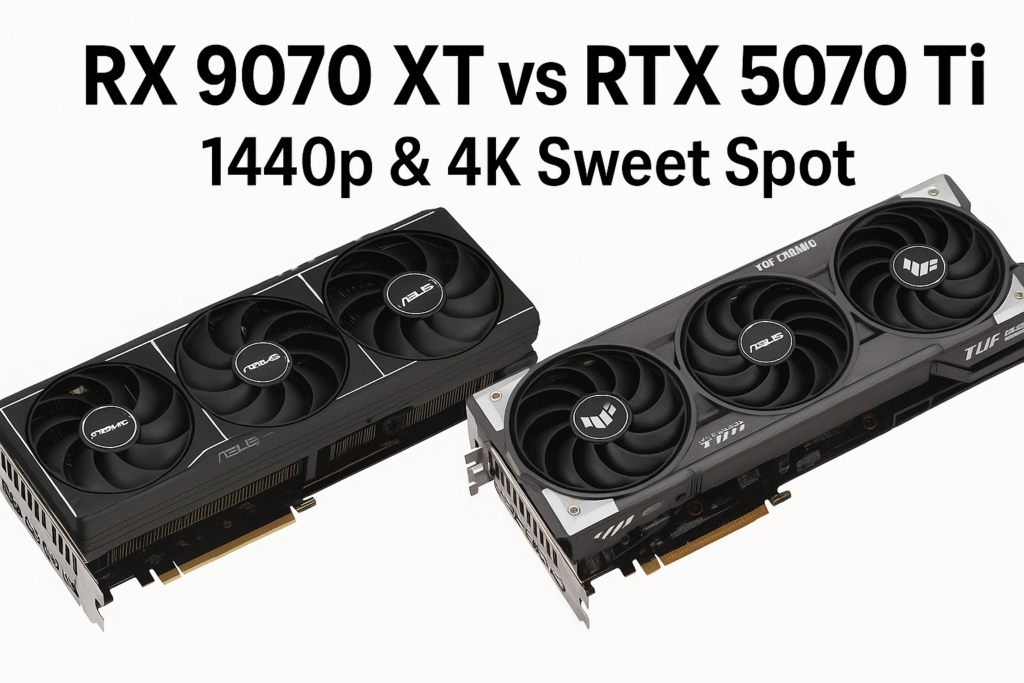
If you’re eyeing a $3k–$4k build, you’re probably deciding between Nvidia’s RTX 5070 Ti (16GB) and AMD’s RX 9070 XT. Both hit the sweet spot between 1440p ultra-high refresh and entry-level 4K gaming — but which should you choose?
Why These Two Cards Matter in 2025
- Both come with 16GB VRAM, enough for modern AAA titles at high settings.
- They represent the best performance-per-dollar without going into $8k–$10k flagship territory.
- With upscalers like DLSS 4 (Nvidia) and FSR 4 (AMD), these GPUs comfortably stretch into 4K territory.
(Related read: [Nvidia vs AMD Graphics Card: Which Is Right for You?])
When the RTX 5070Ti Makes Sense
Competitive gaming at 1440p/240Hz, where latency and frametime stability matter.
Streamers and creators who benefit from Nvidia’s NVENC encoder and CUDA acceleration.
Buyers who want the most plug-and-play ecosystem with mature drivers and broad DLSS 4 support.
When the RX9070 XT Wins
Single-player, cinematic titles where raster performance is king.
Entry-level 4K/120Hz setups with FSR 4 enabled.
Buyers who want maximum raw value without stepping up into RTX 5080/5090 price brackets.
The High-Spender’s Angle
If you’re already investing in a premium monitor (1440p/240Hz or 4K/144Hz), don’t skimp on your GPU match.
- A 5070Ti build shines when paired with high-refresh esports panels.
- A 9070 XT build feels right on a cinematic 4K display.
Either way, the GPU should be part of a balanced luxury system: Ryzen 9 / Core i9, 32–64GB DDR5 RAM, premium PSU, and silent cooling.
(Related read: [High-End Gaming PC in Singapore: 5 Tips for Ultimate Performance])
Common Misconceptions
“Only a 5090 can do 4K properly.” With upscalers, the 9070 XT and 5070 Ti are more than capable for most buyers.
“AMD GPUs are unstable.” Not true in 2025 — driver maturity and FSR 4 adoption have closed the gap.
Final Word
Both GPUs are excellent choices. It comes down to your monitor, games, and expectations.
👉 Need help matching your GPU to your monitor and budget? Reach out for a consultation and I’ll recommend the no-regrets choice for you.

Pingback: Zack Custom PC – Hz vs FPS: What Actually Matters for Gaming